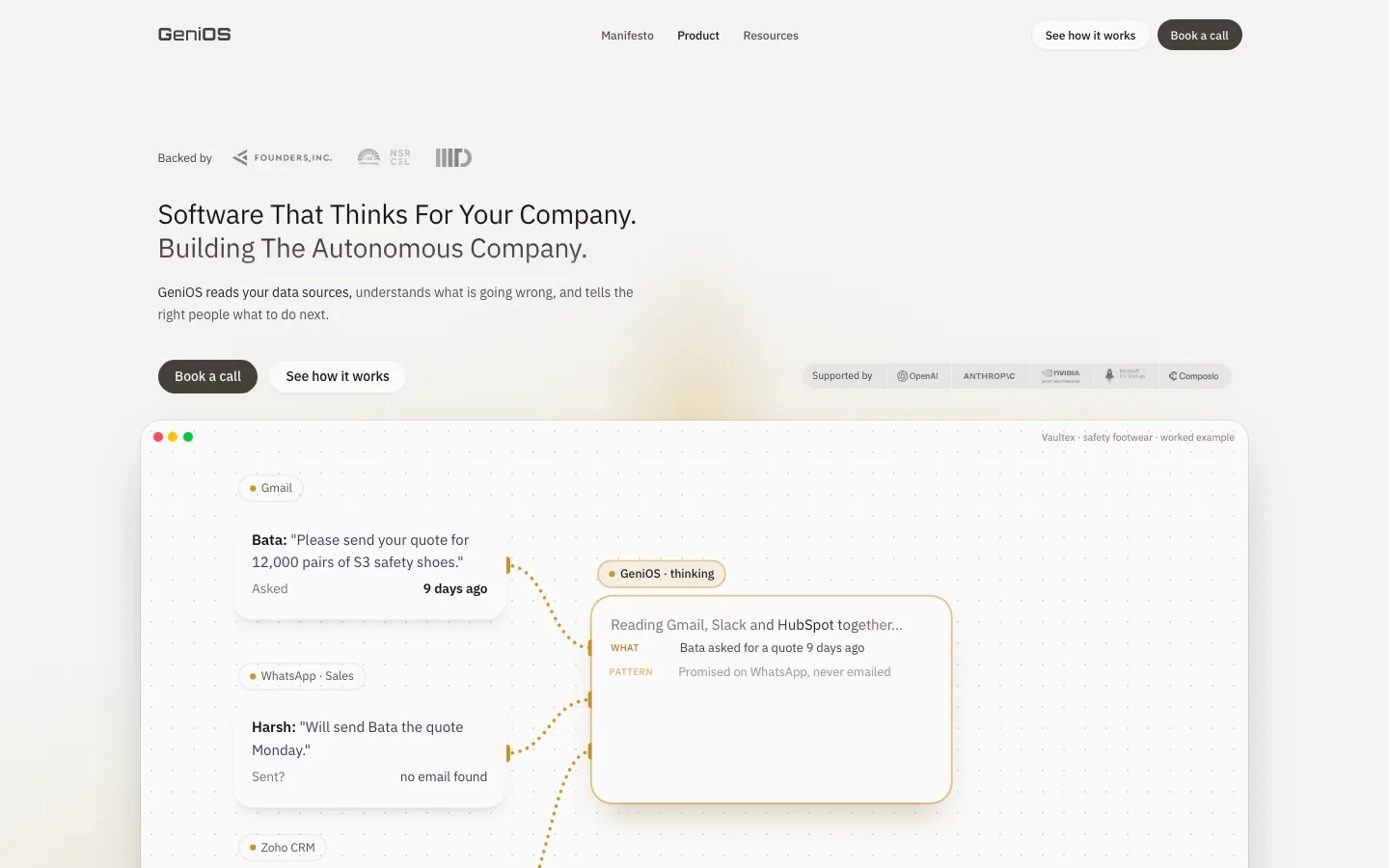
GeniOS is the autonomous company: software that reads everything a company runs on, works out what is going wrong, and tells the right person or agent what to do next. It is my sixth startup, and everything the first five taught me went into it.
What is breaking inside companies
The work lives in the tools. The thinking still lives in people's heads.
A company today runs on Gmail, Slack, WhatsApp, the calendar, a CRM, docs, sheets and meeting notes. It now runs AI agents too, each doing one job in one place. None of these systems knows what the others hold, so people carry the links between them.
In most companies, every goal lives in someone's head and every follow-up waits for someone to remember. The deal that went cold, the investor nobody followed up, the renewal that slipped: none of it looked big when it happened.
More tools gave us more places to look. Nobody got more time to look.
I heard the same thing in more than 500 conversations with founders, COOs, CFOs and heads of AI. The tools are in place. The thinking is still done by hand.
How we see the future
A company that remembers every goal and closes every loop.
We believe the next great companies will run themselves, in a concrete sense. The company knows its own goals and sees the work moving toward them. It notices when something slips, works out why, and sends the next step to the right owner, a person or an agent. When the step is done, it checks the proof and learns from the result.
- Signal
- One person's memory
- Maybe someone acts
- Nobody checks
- Signal
- Reason
- Owner acts
- Proof
- Learn
Today the loop runs through one person's memory and leaks wherever that person is busy. In an autonomous company it closes inside the company, every day, for every team. Autonomous does not mean empty. People set direction, make the judgement calls and approve what goes out. They stop reading five tools every morning to learn what is going on.
Read the full manifesto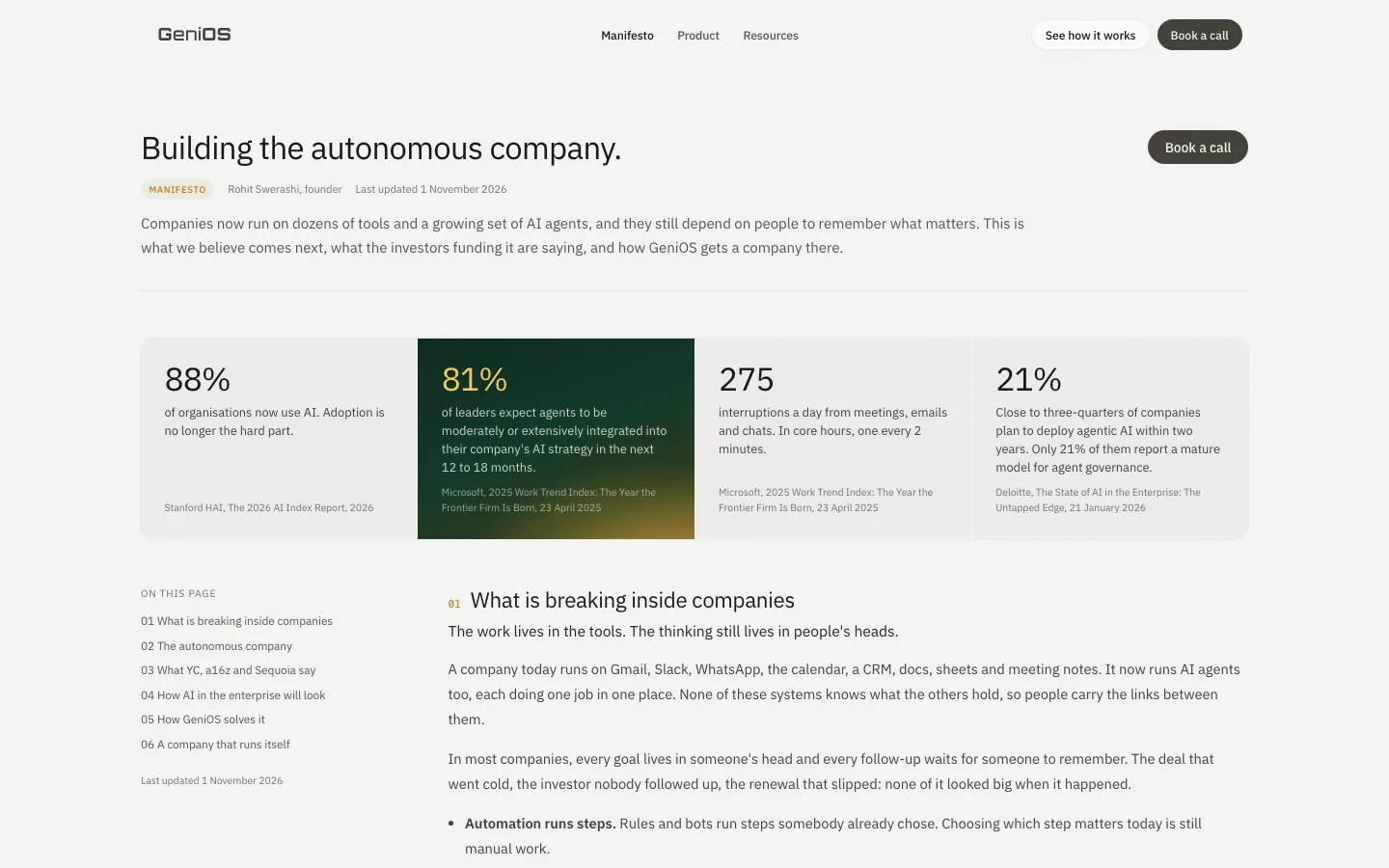
Why the usual answers fall short
Each of these is useful. None of them sees the company.
| What it does well | Where it breaks | |
|---|---|---|
| Automation | Runs the steps somebody already chose | Choosing which step matters today is still manual |
| AI agents | Send 40 follow-ups in a minute | They do what you say, not what the company needs |
| Skills and playbooks | Run one defined process well | Built for one goal, on a state that keeps changing |
| More people | Bring judgement to the hard calls | Every hire adds handoffs, and context leaves with them |
| GeniOS | Decides what matters and hands it to the right owner | Still asks a human before anything goes out |
Why not a company brain
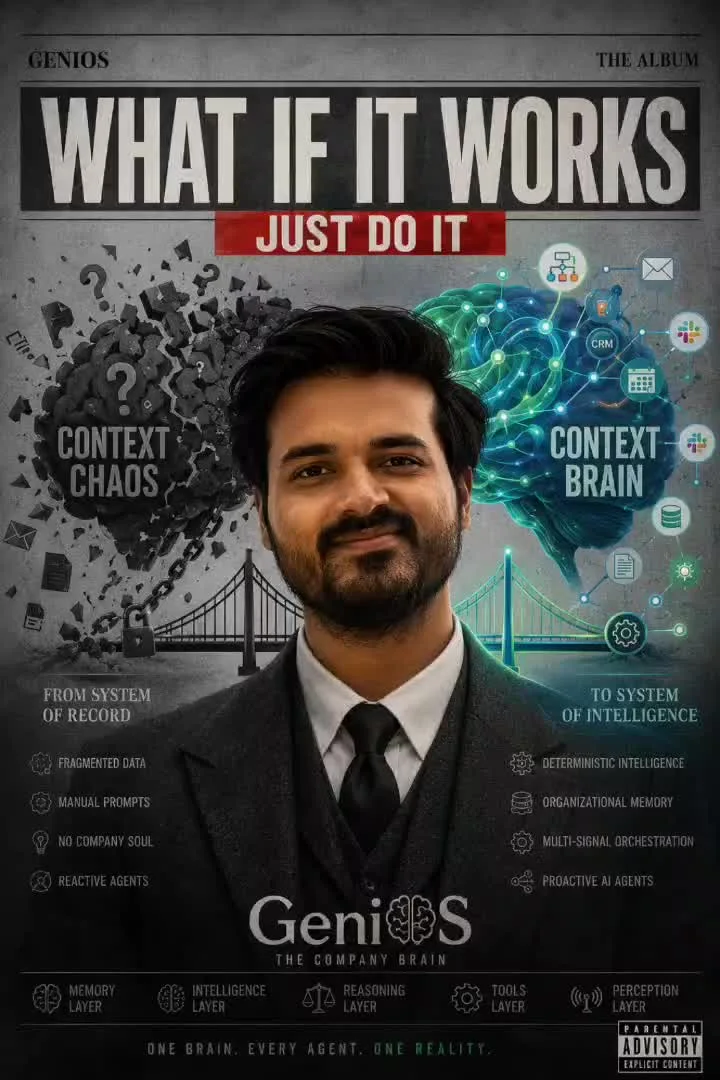
A brain remembers. GeniOS decides.
A memory layer holds every message and answers when asked. Someone still has to know what to ask. That is the difference between memory and intelligence, and it is why we rebuilt the product after building a context brain ourselves.
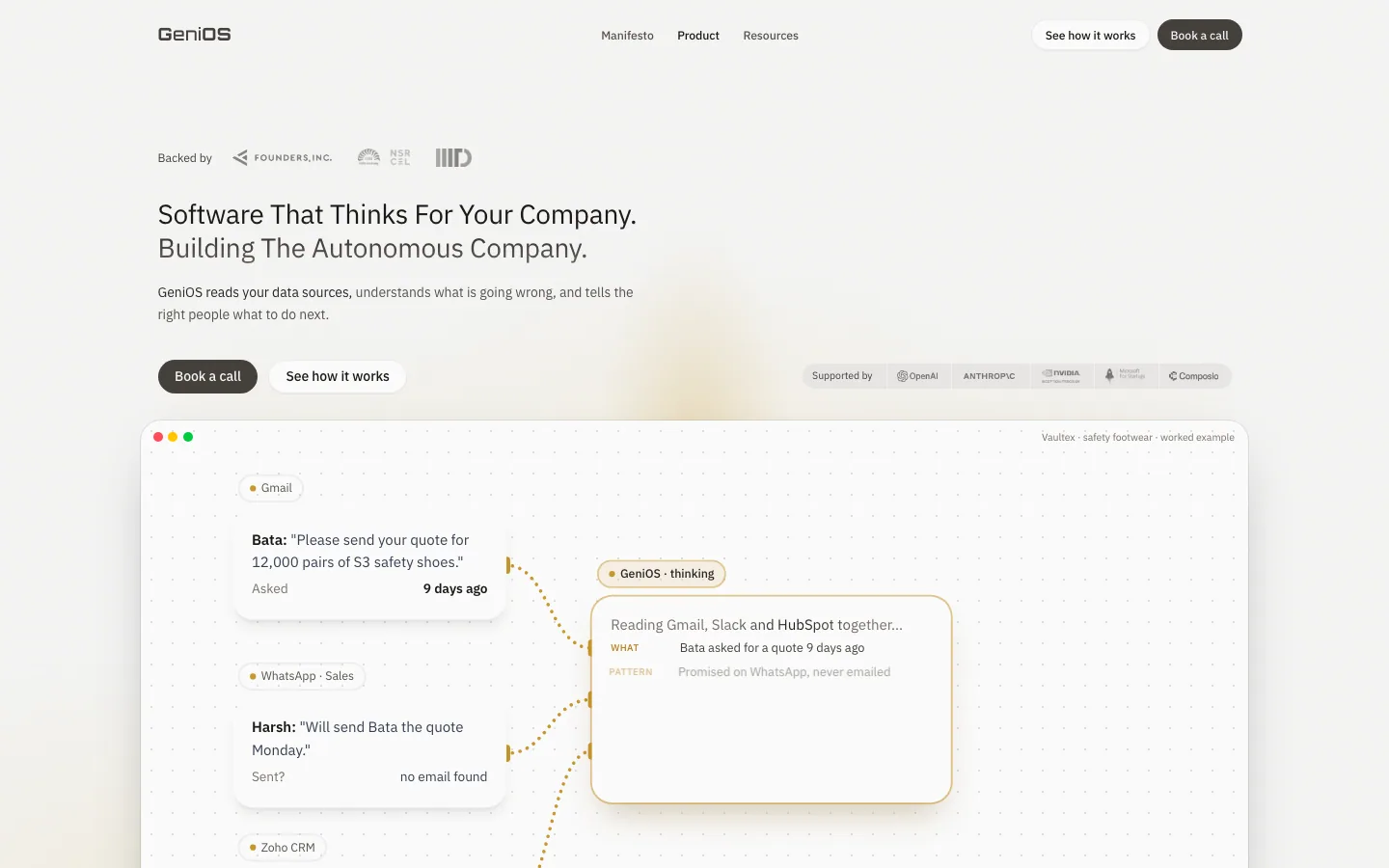
GeniOS does not wait for the question. It notices that a quote promised on WhatsApp never reached the buyer, that a delivery date never reached production, that the review is on Friday, and it says so before anyone thinks to look.
Read GeniOS vs GBrainRead Memory vs IntelligenceHow GeniOS works
One loop, for every goal, every day.
- 01Read
Gmail, Slack, WhatsApp, calendar, CRM, docs, sheets and meeting notes. Read-only to start.
- 02Goals
It forms the company's goals from its own emails, decks and meetings.
- 03Reason
What happened, what the pattern is, what the company context says.
- 04Check teams
Every team's pending work, so it knows who is on it and who is blocked.
- 05Intelligence
One situation, what to do, why, one owner and a date.
- 06Delegate
To a person or an agent. Nothing is sent until a human approves.
- 07Proof
An item closes only when the email, calendar or CRM shows it happened.
- 08Learn
Every outcome and every answer changes what it sends next.
How we got here
Built, pivoted, rebuilt.
- FirstAI employees
Mr. Elite for orchestration, with email and calendar agents. They worked, and they were blind to the company they served.
- ThenContext brain
Persistent memory for agents, after talking to 200+ managers and executives. Better, and it still waited to be asked.
- NowThe autonomous company
Software that decides what matters. 500+ conversations in, with V2 live and 30+ enterprises piloting.
Every day is architecture, product decisions, engineering calls, sales calls and late nights asking if the vision is sharp enough to survive contact with the real world. I still sell it myself.
Where it stands today
The numbers, and who is behind it.
- Backed by Founders, Inc. and NSRCEL IIM Bangalore.
- Incubated at IIIT Delhi Innovation & Incubation.
- Supported by NVIDIA Inception and Microsoft for Startups.
- Advised by senior engineers from Google, IBM and Adobe.
- Used by founders from Y Combinator, Antler, Shark Tank India and Founders, Inc.
Rohit is one of the most talented and inspiring leaders I've come across. When he first shared GeniOS with me, I immediately knew he was onto something groundbreaking.
Aakriti Aggarwal, AI Research Engineer at IBM
What the investors are describing
The people funding the next companies describe the same shape.
Building this today requires brutal integration work, and there's no product that connects all this context into a single layer that can reason across it.
The leverage is not in the weights, it's in how you wire the work.
From India, for the world
India did not invent the internet; we built its software. India did not invent the cloud; we ran it. I want the next chapter of intelligent companies to be built from here.
What shipped
- 01. Backed by Founders, Inc., NSRCEL IIM Bangalore and IIIT Delhi Innovation & Incubation.
- 02. Supported by NVIDIA Inception and Microsoft for Startups.
- 03. Named in the Top 60 Startups of Delhi NCR.
- 04. Advised by senior engineers from Google, IBM and Adobe.