Market Research
Competitors, reports and customer conversations, turned into a clear view of what to do next.
Eight builds, 500+ conversations and three pivots, from an AI mentor for students to GeniOS. This is how my thinking changed, and what changed it.
A running log of the agents and tools behind each build.
I use AI through the whole work of building a company, to move faster and think harder, without handing over judgment.
Before a week goes into the wrong thing.
Competitors, reports and customer conversations, turned into a clear view of what to do next.
Challenging assumptions and testing the reasoning before a week of work goes into the wrong thing.
A dummy first, then real code, then proof.
A clickable dummy first, so a design gets judged by using it, before any real files change.
Real products, with real tests. Not just vibe coding: systems thinking, architecture and scale.
Scripts decide if it passes. A green run is evidence; a claim is not.
What actually goes out into the world.
Email, calendar and orchestration agents, built on LangGraph, Gemini and Supabase.
Long-form explainer films on autonomous companies, made end to end, from research to final render.
thegenios.com went from plan to live with AI in the loop. So did this site.
I did not start with a theory. I built something, put it in front of people, listened to what broke, and built the next thing on top of it.
What it taught mePeople do not need more answers. They need the next step, and someone checking they took it.
What it taught meAn agent wins when nobody has to learn anything to use it.
What it taught meOrder and policy make agents safe. They do not make them useful.
What it taught meIt did what you said, not what the company needed.
What it taught meMost of the job is knowing what not to do, and agents had no way to know that.
What it taught meA chief of staff is useless if it does not know the company.
What it taught meMemory answers what happened. Nobody was answering what should happen next.
What it taught meThis is the part nobody had built.
We were building a context brain. Then the market started telling us the same thing, from four directions.
Vendors are converging on the same features: vector store, hybrid search, graph relationships, temporal decay and entity resolution. On the standard benchmarks they all land in the same place. When Garry Tan built GBrain in twelve days and open-sourced it, the question answered itself. People will build this themselves.
A deal at risk shows up as a shift in tone and slower replies. A launch slipping shows up as dependencies nobody closed. None of that is a fact you can retrieve. People infer it from patterns, and search, however good, does not.
It is the obvious next idea, and it fails for three reasons. Without routing it over-retrieves noise and costs climb. Without per-company thresholds, important means the same thing to a 12-person startup and a 4,000-person enterprise. Without precedent, it re-derives answers the company already found.
A wrapper gives plausible answers. Intelligence gives correct ones.
Demos give an agent clean input and one task. Production gives it messy threads, many teams and competing priorities. An agent may know how to execute a task. It may not know whether that task still matters.
| AI memory | Company brain | Company intelligence | |
|---|---|---|---|
| Belongs to | One user and one assistant | The company | The company, for each owner |
| Comes from | What was said to the assistant | Email, meetings, chat, files, records | The same sources, linked to goals and open work |
| Answers | What did I say? | What happened? | What should happen next, and who owns it? |
| Waits to be asked | Yes | Yes | No |
| Done means | It was stored | It can be found | The proof shows it happened |
Sales agents draft, support agents answer, finance agents reconcile. Most of the doing moves to software.
Companies keep adding tools, and each agent sees only its own corner.
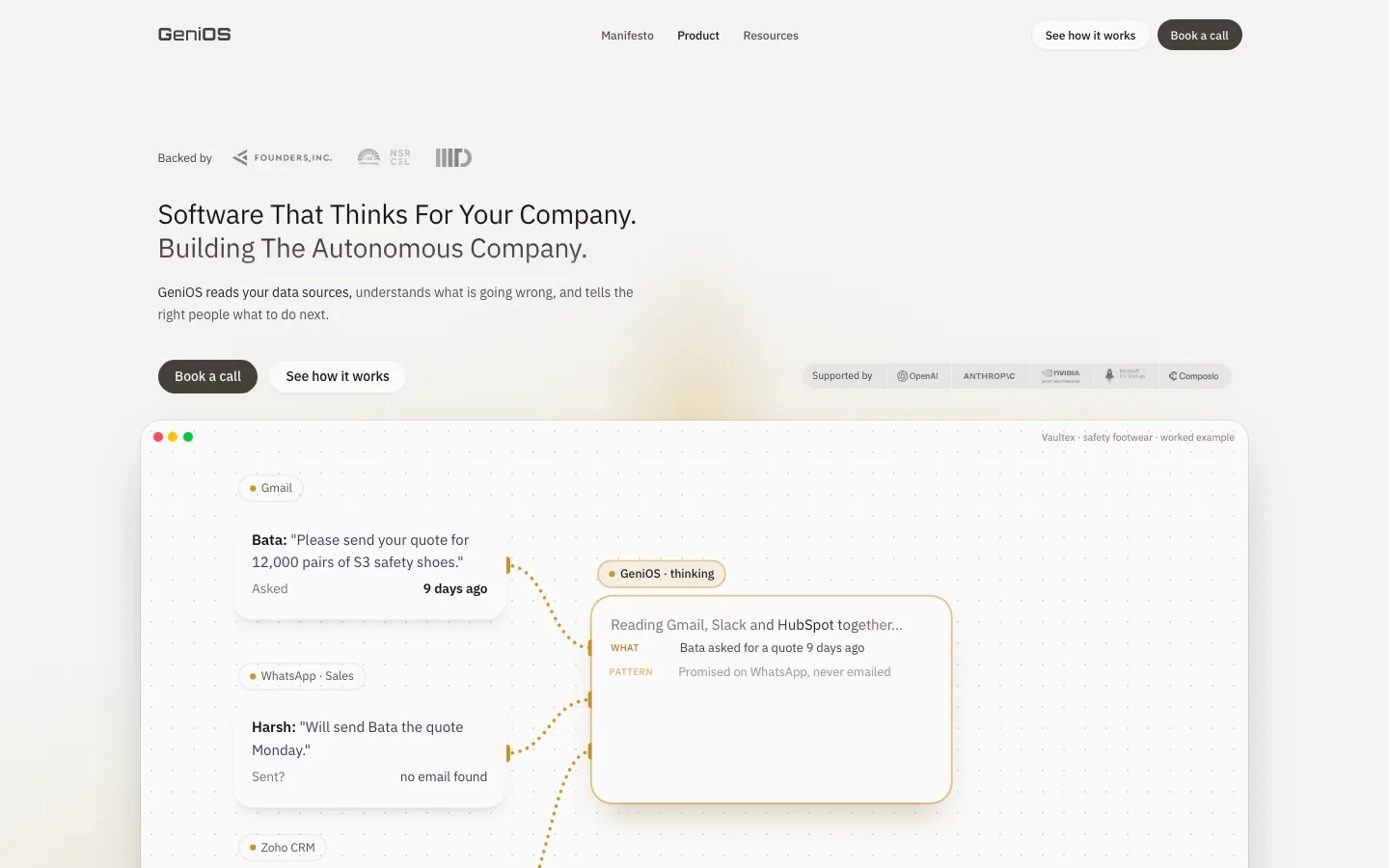
It knows the goals, reads across every system, and decides what matters today and who acts.
They set goals, approve actions and correct the system. Each correction makes the next decision better.
How much work runs from start to proof with a person only approving, and how often a person has to step in.
The manifesto, two long essays on LinkedIn and 30+ articles on thegenios.com.
What is breaking inside companies, how we see the future, and how GeniOS solves it.
LinkedIn, May 2026Memory vs IntelligenceThe company brain is an intelligence problem, not a memory problem.
LinkedIn, May 2026GeniOS vs GBrainGBrain compounds facts. The layer above compounds judgment.
ArticleWhy AI agents fail in productionMissing context, poor coordination, and deciding without current goals.
ArticleOrganizational memory vs AI memoryMemory remembers information. Intelligence understands what it means now.
ArticleDeterministic AI vs generative AIFluent output can still be wrong, so treat it as a proposal and check it.
ArticleWhat is context engineering?The right information, in the right shape, when an AI system acts.
ArticleHow to build an AI-first companyReadable goals, shared promises, one owner per item, proof of work.
ArticleThe future of enterprise AIFrom copilots to task agents to a company that runs itself.
Reached for daily. Short on purpose.